Learning from Changelooms, the efforts of Janta Express Welfare Foundation, and one woman’s determination—Sangeeta Kumari (Fictional) built a livelihood from waste cloth and bamboo, transforming her life and her village
A rural woman transformed her life by turning waste materials and bamboo into sustainable income with the support of Janta Express Welfare Foundation and climate training. Read the full story below.
WOMEN EMPOWERMENT & SUSTAINABLE LIVELIHOOD
Author: By JEWF Team
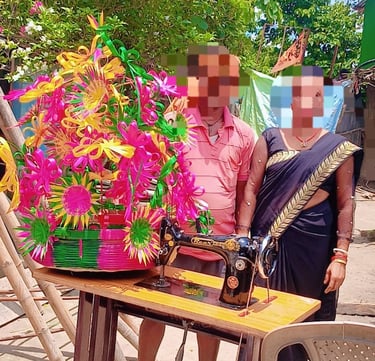
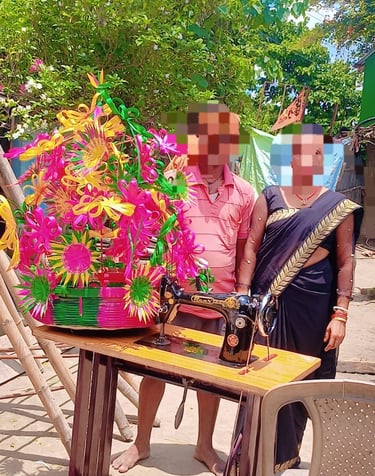
Learning from Changelooms, the efforts of Janta Express Welfare Foundation, and one woman’s determination—Sangeeta Kumari (Fictional) built a livelihood from waste cloth and bamboo, transforming her life and her village
In Mahesh Bathna village of Kishanganj district, life has always moved forward amid struggles. The story of 26-year-old Sangeeta Kumari (Fictional), a resident of this village, was no different. The responsibility of three children, limited income, and constant uncertainty about the future had confined her life within a narrow circle. Her husband worked in agriculture, but the income was not sufficient to run the household smoothly.
Sangeeta Kumari (Fictional) had the desire to do something, but she lacked direction. In the village, a stitching training center was already being run by Janta Express Welfare Foundation, where several women were learning tailoring. Sangeeta Kumari (Fictional) was one of those women who wanted to learn skills and gradually stand on her own feet.
Meanwhile, a significant change began—not directly from the village, but from a larger platform. Under Changelooms, Janta Express Welfare Foundation was selected. Following this, two members of the organization—Roshni Perween and Quasim—were invited to participate in various Changelooms Cohort 3 programs. In these sessions, participants from across the country discussed climate change, its impacts, and possible solutions in detail. The concept of “waste to best,” transforming discarded materials into useful products, was also introduced there.
When Roshni Perween and Quasim returned from these programs, they didn’t just bring back knowledge—they brought a vision to implement it on the ground. They began conducting discussions in different places to spread awareness about climate issues. As part of this effort, women at the stitching center in Mahesh Bathna were also introduced to climate-related ideas.
Sangeeta Kumari (Fictional) was among those who took this knowledge seriously. When she learned that old and discarded clothes could be turned into useful products, she decided to adopt the idea. She began making bags and other small items from old fabrics. For her, this was not just work—it was a new way of thinking, where even limited resources could create opportunities.
During this time, the organization’s mentor Ranjan Bhattacharya visited Kishanganj to guide and strengthen the work being done. When he visited the Mahesh Bathna center, he observed the activities and provided several valuable suggestions. One of his key suggestions was that bamboo, being environmentally friendly, could also be used to create various useful products.
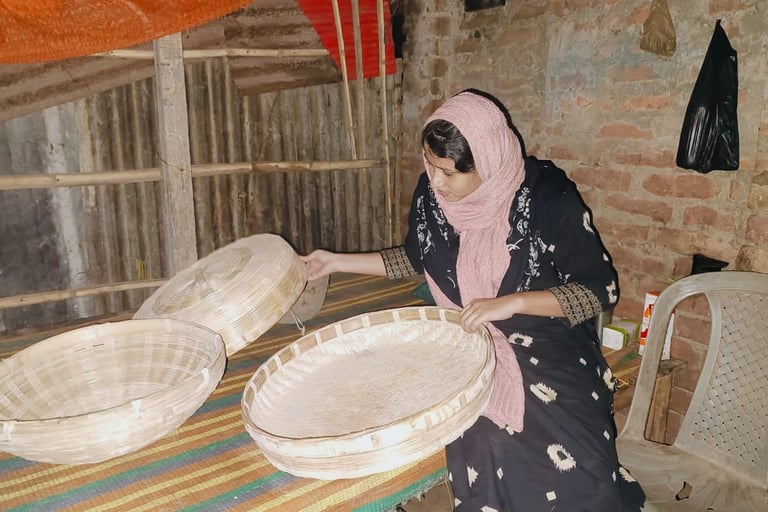
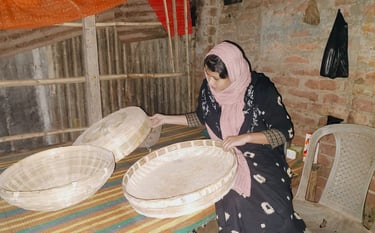
This suggestion opened up a new opportunity for the women. Since bamboo products were already being made in the area, it was easier to adopt this idea. It was also the festive season, when market demand was higher. Recognizing the right timing, Sangeeta Kumari (Fictional) and other women immediately started making bamboo products such as baskets, winnowing trays, and other household items.
Gradually, these products began to sell, and people appreciated them. This not only increased their income but also strengthened their confidence. Sangeeta Kumari (Fictional) was no longer limited to stitching; she had now created a sustainable source of income through climate-friendly products.
Today, many women in Mahesh Bathna are engaged in producing bamboo and cloth-based items and selling them in the market. The financial condition of Sangeeta Kumari’s (Fictional) family has improved significantly. Her children are going to school, the household situation has stabilized, and most importantly, she now looks at the future with confidence instead of fear.
The journey of Sangeeta Kumari (Fictional) is not just the story of one woman—it is the story of transformation made possible through the right information, timely intervention, and proper guidance. The learning from Changelooms, the efforts of Janta Express Welfare Foundation, and the determination of women together prove that when given the right opportunity, women in villages can change the direction of their lives.
© 2024–2025 JEWF. All Rights Reserved.
JEWF
────── ❤ ─────
│
│
│
│
│
│
│
Menu